Web 3.0 - Solution To Big Problems
Learn how web 3.0 is solving big problems i.e Privacy & Ownership of Data.

A Full Stack Software Engineer(JavaScript) who’s passionate about creating content that can be of value to others. Besides juggling work, content creation and other commitments, I can be found traveling to contemplate the meaning of life under the stars 🌠
Hello & Assalamualaikum Everyeone! 👋
I hope you are doing fine. In this article, we will understand what Web3 is and how it's solving one of the biggest problems in our society that is privacy & ownership.
Let's jump in 🚀
What Is Web 3.0?
Web 3.0 is an idea for a new iteration of the World Wide Web, incorporating concepts such as decentralization, blockchain technologies, and token-based economics.
At first, this sounds a little confusing. But to simplify the concept, let’s take a step back and understand what Web 1.0 and Web 2.0 are.
Web 1.0
Web 1.0 was the first ever iteration of the World Wide Web. It’s also known as the Read Only Web because most people using web 1.0 were only consumers, not creators. Only developers could create content via HTML static pages and serve it to the public. The internet was like a library that people used to visit for information, and the authors were developers & technical people.
Web 1.0 lasted approximately from 1991 to 2004.
Web 2.0
Web 2.0 was the second iteration of the World Wide Web. It’s also known as the Read/Write Web or Interactive Web because now, the consumers also have the authority to create content. Creation is not only limited to technical people.
You can interact with the content as an average consumer. And social platforms like Facebook, Twitter, etc., are built for interactivity. Web 2.0 is simple to use, and because of this simplicity, more and more people worldwide are becoming creators.
Here Comes, Web 3.0
Now we understand that web 1.0 is all about reading and web 2.0 is all about Read/Write. Web 3.0 introduces another element called Own. So web three is an extended version of web 2.0 where you can interact and own your data.
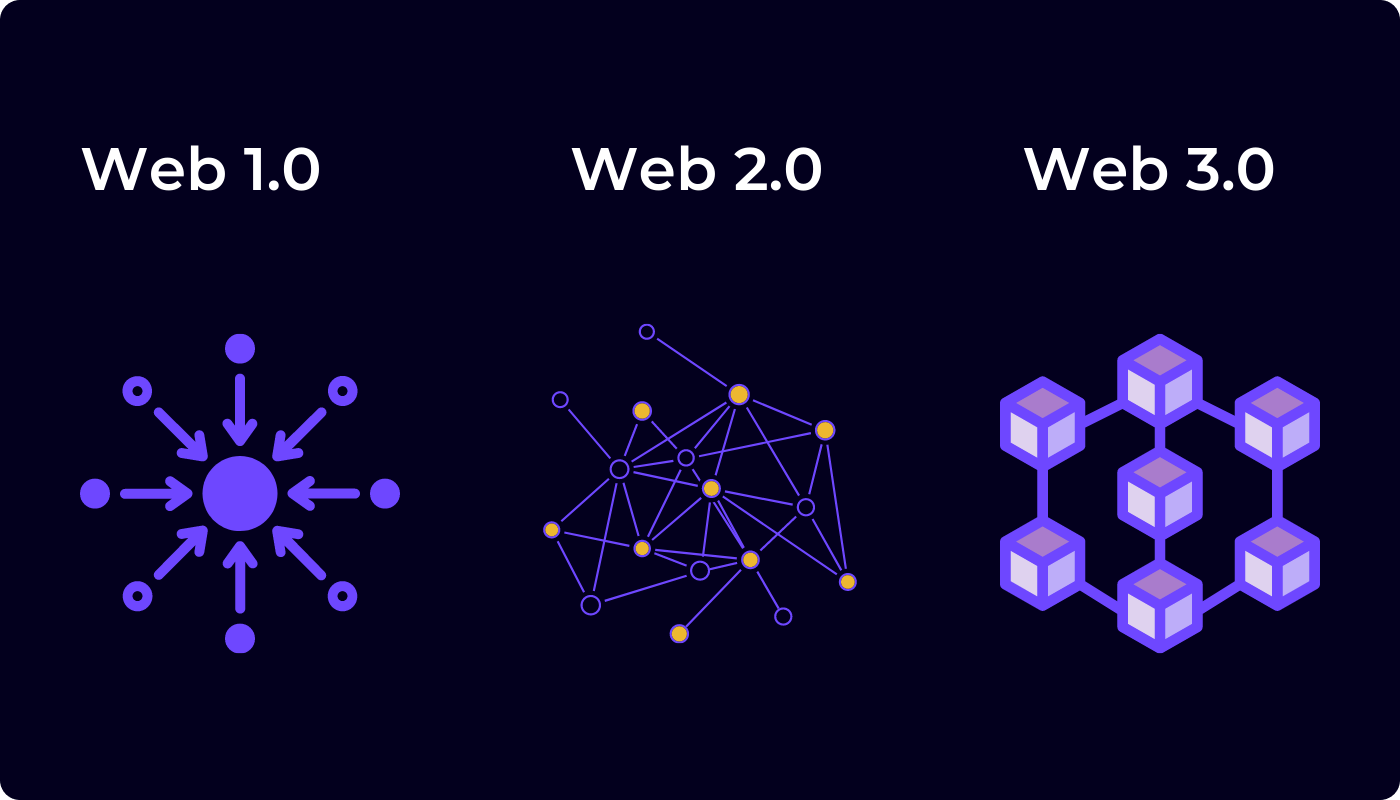
Nowadays, all the big platforms, like Google, Facebook, Instagram, etc., are entirely controlling your data. That means the ownership of your data is not in your hand. They can use your data for any purpose, and you can’t do anything, sadly. Also, data breaches are standard on many big platforms. Web 3.0 is solving this big problem and letting you take complete ownership of your data.
How Does Web 3.0 Work?
In web 3.0, your data is stored on your crypto wallet. You’ll engage with apps and communities on web 3.0 through your wallet and take your data with you when you are not using the apps. And when you own your data, you’ll also be able to decide if you want to monetize it or not.
In web 3.0, apps will be run by decentralized autonomous organizations (DAOs). This means that instead of a central administration making all the decisions, decisions are made by users with governance tokens. In a traditional company, shareholders vote on changes in the business, which falls on the CEO to implement. In a DAO, token holders get to vote on any proposed changes implemented into the DAO’s code instantly via a smart contract if the changes are approved. Because DAOs are democratized, everyone can access the DAO’s source code.
Problem Web 3.0 Is Solving
Data Ownership
End-users take full ownership of the data using Web 3.0 provided by the blockchain. Data sent over the network is encrypted. Users can choose what information they want to share with businesses and advertising companies and make money from it.
Data Protection & Security
Web 3.0 features include professional and data protection models. It promotes non-centralized operating systems that keep control over their users’ data. The data breach incidents will be few because now, the users have control over how their data is viewed.
Easy Access To Information
One of the main advantages of Web 3.0 is the ability to access data from anywhere, mainly due to the widespread use of smartphones and cloud applications.
The vision is that the user anywhere in the world can access information as much. This technology aims to expand the concept by allowing devices to collect user data and smartphones to access data on your computer.
Conclusion
Web 3.0, is the idea of the next generation of the Web. It is where most people will be connected on a decentralized network, and people will also have control of their own data.
The advantages of Web 3.0 are that it will make the internet much faster as well as easier to search for information. It's solving and maturing day by day and there is a huge demand for web 3.0 engineers and security analysts who are needed to make this transition more secure and smooth.
I hope this article was a good read for you. Do share it with your friends and other peers. If you know any resources that can help in understanding web 3.0 and learning it, please share them in the comments with me and everyone. It will be helpful!
Thank you so much! ❤️


